
It’s not often that engineers and marketers see eye to eye. Engineers care about precision, specifications, and getting the details right. On the other hand, marketers focus on persuasion, engagement, and conversions. More companies today are bridging that difference with technical storytelling animation.
With a well-made animation, engineers can see their work accurately represented while marketers get a story that helps the audience understand why the product matters. The divide between the two was never really about different goals. It was about finding the right way to translate technical ideas into something people can connect with.
What Is Technical Storytelling Animation?
Technical storytelling uses 2D or 3D motion graphics to simplify and explain how a product works, what problem it solves, or how to use it. Instead of walking through technical specifications, animation lets companies build an explanation around a narrative structure.
This technique sequences information the way a person actually needs to receive it. It tells the audience the problem, what happens inside the product, and why it matters to them. The technical accuracy of an engineering drawing stays intact. What changes is the delivery, such as the pacing, the visual emphasis, and a hook that gives the viewer a reason to keep watching.
It combines three disciplines that don’t usually share a table: (1) technical and instructional design, (2) 3D visualization, and (3) narrative-driven marketing content.
Why Do Engineers and Marketers Usually Disagree on Product Content
There seems to be a constant tension between engineers and marketers on every product content project. It’s usually driven by two things:
1. Engineers Are Accountable for Technical Accuracy
They’ve spent months or sometimes years working through the details, from tolerances and materials to how every part actually works. When it’s time to build out the content, they would naturally want to show the full picture. Since their focus has always been on accuracy, they would push to use the right terminology, highlight specs, and avoid leaving anything out. For most engineers, oversimplifying feels like introducing risks.
2. Marketers Are Accountable for Audience Clarity and Engagement
They know they only have a few seconds to grab someone’s attention and make the product easy to understand. For marketers, a technically perfect explanation doesn’t mean much if the audience loses interest before they get to the point.
In most cases, engineering wants a detailed, feature-by-feature explanation while marketing wants something clear, fast, and more engaging. Neither side is necessarily wrong, but the back-and-forth can lead to endless revisions, delayed approvals, or content that ends up too technical for the audience or too simplified for the people who built the product.
Why Technical Storytelling Animation Finally Gets Both Sides to Agree
The disagreement between engineers and marketers is primarily rooted in whether narratives can be trusted to convey accurate product information. Technical storytelling animation settles that by using narrative as the delivery mechanism and not a replacement for the substance in CAD files.
The goal isn’t to strip away technical detail. It’s to make the right details visible at the right moment, in the right sequence, so the audience can follow the story.
For example, a data sheet is built to show you everything at once. It’s useful, but for a customer or stakeholder seeing the product for the first time, the same approach can make it harder to stay engaged. A narrative takes the same information and gives it some context. It draws the viewer in first, then introduces the details when they have a reason to matter. After all, a feature means more when you understand the problem it solves.
That context is what moves buyers. Buyers understand a feature more quickly when it’s tied to an application or a problem they recognize. In the same way, technical content is more effective when the viewer understands why a feature matters and not just what it does. The strongest technical stories start with the problem the audience needs to solve, then show how the product addresses it.
That’s where engineering and marketing meet. Engineering gets accurate technical representation rooted in CAD and technical data while marketing gets a narrative that helps buyers understand why those details matter.
Neither side has to compromise.
How to Choose a Partner for Technical Storytelling Animation
Before you choose a technical storytelling animation partner, check for these four things:
☐ Do they work directly from CAD files?
Ask how they turn engineering files into production-ready 3D assets. Your animation should be based on the same engineering data used to design the product, so what viewers see matches how it actually works.
☐ Do they include engineering in the review process?
A strong partner should be comfortable working with both engineering and marketing teams to catch technical issues without losing the story.
☐ Can they reuse 3D assets across different content?
A well-prepared 3D asset should be able to support more than a single animation. It should also work for renders, installation guides, training materials, sales presentations, and trade shows. This can extend the value of your original investment.
☐ Do they know how to make technical information easy to follow?
The goal isn’t to remove the technical details. It’s to organize them into a visual story that’s easier for customers, sales teams, and stakeholders to understand.
Bonus tip: A good partner should be able to create launch-ready visuals before prototypes or finished products are available, helping marketing stay ahead of production.
Want to see how this process works in practice? Take a look at how Info-Graphics turns CAD files into detailed industrial machinery visualizations, from the initial engineering data to the finished visuals. See how we do it at Info-Graphics.
From Technical Details to a Clear Product Story
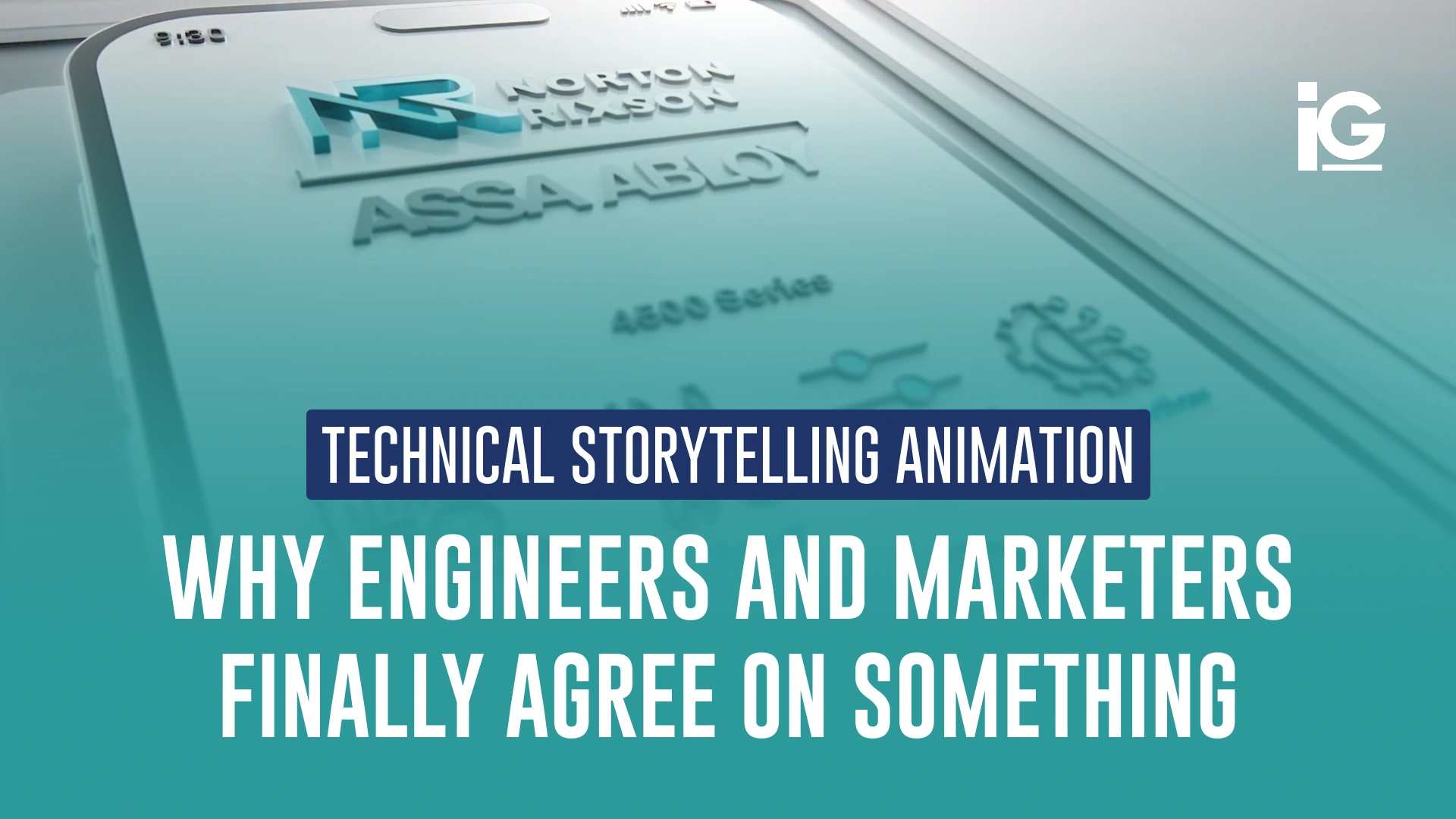
A good example of technical storytelling is Info-Graphics’ work for Norton Rixson’s NROS™ system. The product connects a phone or laptop to a door operator via its own wireless hotspot, so users don’t need to set up Wi-Fi.
Rather than simply listing those features, the product animation shows how the system works and walks viewers through the setup, adjustments, and configuration. The result is a technical product story that makes a complex system easier to understand without leaving out the details.
See full details on the Norton Rixson NROS product animation →
Have a Complex Product to Explain?
If your product is difficult to explain, the right visual story can make the engineering easier to understand without losing the technical detail. Info-Graphics works directly from CAD and engineering data to build animations and visual content that support both technical accuracy and audience clarity.
Have a product in mind? Tell us about it and let’s see what your CAD can become.
Frequently Asked Questions (FAQ)
Technical storytelling animation combines 2D or 3D animation with a clear story. It can be built from CAD files and engineering data to show how a product works, but it also puts those details into context. Instead of simply listing features, it helps viewers understand what the product does and why it matters.
Not necessarily. Since the animation can be created from CAD and engineering files, you don’t need a physical prototype. That means marketing, sales, and trade show materials can be developed while the product is still in development.
It can be, especially when you’re selling a complex product that takes time to evaluate. The same 3D assets can support product launches, trade shows, sales presentations, training, and technical documentation. That makes one animation useful across multiple stages of the buyer journey rather than just for a single campaign.




Leave A Comment